Hyperliquid Testnet Guide: Faucet, API and Paper Trading
Hyperliquid testnet lets traders practise the interface and developers test signed API workflows with mock assets. It is a separate environment: use the testnet app, faucet and endpoints, and do not treat its liquidity or results as a forecast of mainnet execution.
Direct answer
How do you use the Hyperliquid testnet?
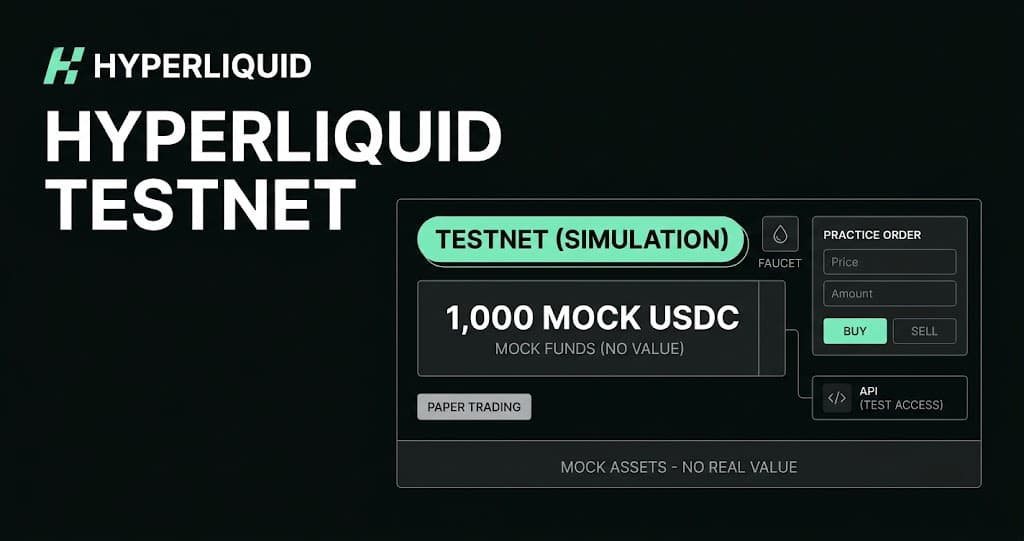
Open app.hyperliquid-testnet.xyz, connect an EVM wallet, then claim 1,000 mock USDC from the official /drip faucet. Faucet eligibility currently requires that the same wallet address has previously deposited on Hyperliquid mainnet. Use the mock balance to practise orders or test integrations without risking real trading capital, while remembering that testnet markets and liquidity do not reproduce mainnet exactly.
Updated 26 Oct 2026
On this page
- What are the official Hyperliquid testnet links?
- How does the Hyperliquid testnet faucet work?
- Do you need to deposit real money to use the faucet?
- Why can email login cause a testnet wallet mismatch?
- How do you paper trade on Hyperliquid testnet?
- What should you practise before moving to mainnet?
- What is different between Hyperliquid testnet and mainnet?
- How do you use the Hyperliquid testnet API?
- How do you configure the Python SDK for testnet?
- What should an API test plan cover?
- Is the HyperEVM testnet faucet the same as the trading faucet?
- Why is Hyperliquid testnet not working?
- Is Hyperliquid testnet risk-free?
- The bottom line
Hyperliquid testnet is a separate deployment used for learning and development. Its balances are test assets rather than mainnet trading funds. The interface still sends signed actions to an onchain order book, so it is useful for learning order placement, margin, TP/SL behavior, fills, cancels and API error handling before working with real capital.
Calling it paper trading is convenient, but testnet is not a replay simulator. Its participants, order books, market list, position limits and liquidity can differ from mainnet. A strategy that fills cleanly on testnet may slip, reject or behave differently under mainnet volume and volatility.
What are the official Hyperliquid testnet links?
| Service | Official address | Purpose |
|---|---|---|
| Trading app | https://app.hyperliquid-testnet.xyz | Manual paper trading and account controls |
| Mock-USDC faucet | https://app.hyperliquid-testnet.xyz/drip | Claim test trading collateral |
| REST API | https://api.hyperliquid-testnet.xyz | Read data and submit signed actions |
| WebSocket | wss://api.hyperliquid-testnet.xyz/ws | Stream testnet market and account updates |
| HyperEVM RPC | https://rpc.hyperliquid-testnet.xyz/evm | Test smart contracts and EVM transactions |
How does the Hyperliquid testnet faucet work?
The official testnet faucet currently provides 1,000 mock USDC for HyperCore trading. Hyperliquid requires the same address to have deposited on mainnet before it can claim. The requirement checks address eligibility; it does not transfer the mainnet deposit into testnet or turn mock USDC into a redeemable asset.
Claim mock USDC
Use the eligible wallet address
Connect the same EVM address that previously made a Hyperliquid mainnet deposit. A different address will not inherit that eligibility.
Open the official testnet app
Navigate directly to app.hyperliquid-testnet.xyz and confirm that the connected address matches the eligible mainnet address.
Visit the drip page
Open /drip from the testnet domain. The current official documentation says an eligible address can claim 1,000 mock USDC.
Sign only the expected request
Read the wallet prompt and reject unexpected approvals, transfers or network changes. A faucet should never need your seed phrase or private key.
Verify the testnet balance
Return to the testnet trading interface and confirm that the mock balance appears before placing any order.
Do you need to deposit real money to use the faucet?
Under the current official rule, the address must have deposited on mainnet. That means a completely new address cannot claim simply by visiting the testnet faucet. A prior deposit is an eligibility condition, not a fee charged by the faucet. Never deposit more than you understand or can afford merely to unlock a test environment.
If the address has already deposited but the claim fails, first compare the full connected address on mainnet and testnet. Wallet extensions can switch accounts silently, and email login creates an additional address complication. Check eligibility and domain before seeking support through official channels.
Why can email login cause a testnet wallet mismatch?
Hyperliquid's official faucet documentation says Privy generates different wallet addresses for mainnet and testnet email logins. The testnet email address may therefore fail the same-address requirement even when the mainnet email account has deposited.
The documented workaround is to export the email wallet from mainnet, import that private key into a compatible wallet extension and connect the resulting same address to testnet. Exporting a private key is security-sensitive: do it only through the verified mainnet settings, never paste the key into a website, and make sure the device and wallet extension are trusted.
How do you paper trade on Hyperliquid testnet?
A useful first testnet session
Record the starting balance
Note the mock-USDC balance so fees, funding and realised PnL can be separated from later deposits or faucet claims.
Choose a liquid test market
Inspect the live testnet book rather than assuming a mainnet market has similar depth or is even listed on testnet.
Place a small limit order
Use a deliberately small size, observe whether it rests or fills, and locate its order ID and status in the interface.
Add TP/SL protection
Test a take-profit and stop-loss order, then check which price triggers it and how a market exit differs from a limit exit.
Cancel and close deliberately
Practise cancelling an open order and closing the remaining position. Confirm that no unintended orders or exposure remain.
Review the complete record
Compare order history, fills, fees, funding and final balance. The review is more useful than whether the mock trade made a profit.
What should you practise before moving to mainnet?
- Connecting and reconnecting the intended wallet and subaccount.
- Reading order-book depth, spread, mark price and liquidation price.
- Placing market, limit, reduce-only and TP/SL orders.
- Recognising resting, filled, partially filled, rejected and cancelled states.
- Changing between cross and isolated margin without confusing their risk boundaries.
- Closing a position and cancelling leftover orders during a fast move.
- Checking fees and funding separately from price profit or loss.
- Recovering state after a refresh, wallet disconnect or WebSocket reconnect.
What is different between Hyperliquid testnet and mainnet?
| Area | Testnet | Mainnet consequence |
|---|---|---|
| Collateral | Mock assets from a faucet | Real assets and real financial loss |
| Liquidity | Different participants and order books | Different slippage and fill probability |
| Markets | Listings and metadata can differ | Resolve current mainnet symbols and asset IDs |
| Margin tiers | Some tiers are lower for easier testing | Mainnet position limits can be different |
| Wallet approvals | Separate testnet authorisations | Test agents do not authorise mainnet actions |
| API URLs | Testnet domains | A wrong base URL can query or trade the wrong environment |
Good testnet results prove that a workflow ran under testnet conditions. They do not prove profitability, mainnet execution quality or resilience during production congestion. Before moving an automated process to mainnet, repeat metadata checks, use a new mainnet API wallet, lower the initial size and verify every safety limit against live mainnet state.
How do you use the Hyperliquid testnet API?
Hyperliquid uses the same general REST request structure on testnet with a different base URL. Read-only info requests go to https://api.hyperliquid-testnet.xyz/info. Signed actions go to the /exchange route on that base. Real-time subscriptions use wss://api.hyperliquid-testnet.xyz/ws.
curl -X POST https://api.hyperliquid-testnet.xyz/info \
  -H "Content-Type: application/json" \
  -d '{"type":"allMids"}'
A successful response confirms that the read path works, but it says nothing about signing. Signed actions must use testnet-specific configuration. User-signed payloads that contain hyperliquidChain should use Testnet rather than Mainnet, and the client must resolve asset metadata from testnet instead of copying mainnet IDs.
How do you configure the Python SDK for testnet?
The official Python SDK exposes TESTNET_API_URL. Start with its read-only Info client, then use the repository's examples for agent approval, orders and cancels. Keep the test account address separate from the API-wallet signing key, and never commit either network's private key to a repository.
from hyperliquid.info import Info
from hyperliquid.utils import constants

info = Info(constants.TESTNET_API_URL, skip_ws=True)
state = info.user_state("0xYOUR_TESTNET_ACCOUNT_ADDRESS")
print(state)
When an API wallet signs, account queries still use the master or actual subaccount address. Querying the agent address is a common reason for an empty account response. Use a dedicated testnet agent and do not reuse it as a mainnet key merely because the code path looks similar.
What should an API test plan cover?
- Fetch metadata and map symbols to the current testnet asset identifiers.
- Read balances, positions and open orders using the correct account address.
- Submit a resting limit order and parse the returned order ID.
- Cancel the order and confirm the final status rather than assuming success.
- Test partial fills, invalid precision, insufficient margin and reduce-only rejection.
- Reconnect WebSocket feeds and rebuild state from snapshots after a disconnect.
- Stop the process safely when market data is stale or expected fields are missing.
- Reconcile positions and orders before the process exits or restarts.
Is the HyperEVM testnet faucet the same as the trading faucet?
No. The /drip faucet supplies mock USDC for trading on HyperCore. HyperEVM transactions require testnet HYPE for gas. Hyperliquid's builder-tools documentation lists third-party faucets such as Chainstack and QuickNode for testnet HYPE. Their limits and availability are controlled by those providers and can change.
| You want to test | Asset needed | Where it is used |
|---|---|---|
| Perpetual or spot trading | Mock USDC | HyperCore testnet trading balance |
| Smart contracts or EVM transfers | Testnet HYPE | HyperEVM gas on chain ID 998 |
The official HyperEVM testnet RPC is https://rpc.hyperliquid-testnet.xyz/evm and its chain ID is 998. Adding that network to a wallet does not create a HyperCore trading balance, and claiming mock USDC does not necessarily provide HyperEVM gas. Treat them as connected but distinct test workflows.
Why is Hyperliquid testnet not working?
| Problem | Likely cause | First check |
|---|---|---|
| Faucet says address is ineligible | Connected address has not deposited on mainnet | Compare the full address and mainnet deposit history |
| Email login address does not match | Privy created different mainnet and testnet wallets | Review the official export-wallet instructions |
| Balance is zero after claiming | Wrong account or stale interface state | Confirm address, refresh and recheck testnet state |
| API returns empty positions | Agent wallet queried instead of account | Use the master or actual subaccount address |
| Order uses the wrong market | Mainnet asset ID reused on testnet | Fetch current testnet metadata |
| Signature is rejected | Network or signed fields do not match testnet | Check base URL, chain name, nonce and SDK configuration |
| HyperEVM transaction cannot send | Wallet lacks testnet HYPE for gas | Check chain ID 998 and EVM balance |
| Test fill differs from mainnet | Order books and participants are different | Treat testnet as workflow validation only |
Is Hyperliquid testnet risk-free?
Mock trading removes direct market loss from the test balance, but wallet and operational risks remain. A malicious site can still request a harmful signature, and an exposed private key can compromise the same address on other networks. Testnet is not a reason to lower wallet-security standards.
- Use verified Hyperliquid domains and bookmark them.
- Never provide a seed phrase or private key to a faucet or support account.
- Keep API secrets outside source code, browser bundles and logs.
- Use separate API wallets for testnet and mainnet automation.
- Read every wallet prompt even when only mock assets are involved.
- Revoke agents and remove test permissions when an experiment ends.
The bottom line
Hyperliquid testnet is best used to validate a process: connect the correct address, claim mock USDC, place and cancel orders, test exits, inspect fills and recover cleanly from errors. It is less useful as evidence that a strategy will earn money or receive the same execution on mainnet.
Keep the environments explicit. The trading app, REST API, WebSocket and HyperEVM RPC all have testnet-specific addresses. Fetch testnet metadata, use testnet-only API wallets and re-verify every assumption before moving even a small version of the workflow to mainnet.
Frequently asked questions
What is the official Hyperliquid testnet URL?
The official trading interface is https://app.hyperliquid-testnet.xyz. The mock-USDC faucet is on the same domain at /drip. Verify the full domain before connecting a wallet.
How much does the Hyperliquid testnet faucet provide?
The official documentation says eligible addresses can claim 1,000 mock USDC. Faucet amounts and eligibility rules can change, so confirm them on the official documentation and drip page.
Why am I not eligible for the Hyperliquid testnet faucet?
The connected address must have previously deposited on Hyperliquid mainnet. Make sure testnet is connected to the exact same address, not another wallet account or a separate email-login address.
Is Hyperliquid testnet real money?
The faucet's mock USDC is test collateral and is not the same as mainnet USDC. Testnet is intended for practice and development, although wallet-signing and private-key risks still remain.
Can I paper trade Hyperliquid without risking trading capital?
Yes, testnet lets you practise with mock collateral. It is not an exact simulation of mainnet, so liquidity, fills, market availability and results should not be treated as a production forecast.
What is the Hyperliquid testnet API URL?
Use https://api.hyperliquid-testnet.xyz for REST requests and wss://api.hyperliquid-testnet.xyz/ws for WebSocket connections. Do not mix these with the mainnet endpoints.
What is the HyperEVM testnet chain ID?
HyperEVM testnet uses chain ID 998 and the official RPC https://rpc.hyperliquid-testnet.xyz/evm. HyperEVM transactions need testnet HYPE for gas rather than the mock USDC supplied by the trading faucet.
Why does my email wallet differ between mainnet and testnet?
Hyperliquid documents that Privy creates different addresses for email login on mainnet and testnet. Its documented workaround is exporting the mainnet email wallet, importing it into a wallet extension and connecting that same address to testnet.
Sources
- Hyperliquid documentation - Testnet faucet↗ external
- Hyperliquid documentation - API overview↗ external
- Hyperliquid documentation - WebSocket API↗ external
- Hyperliquid documentation - HyperEVM networks↗ external
- Hyperliquid documentation - HyperEVM builder tools and faucets↗ external
- Hyperliquid documentation - Export an email wallet↗ external
- Hyperliquid documentation - Margin tiers↗ external
- Official Hyperliquid Python SDK↗ external