Hyperliquid Leverage Explained: Maximum Leverage, Margin and Risks
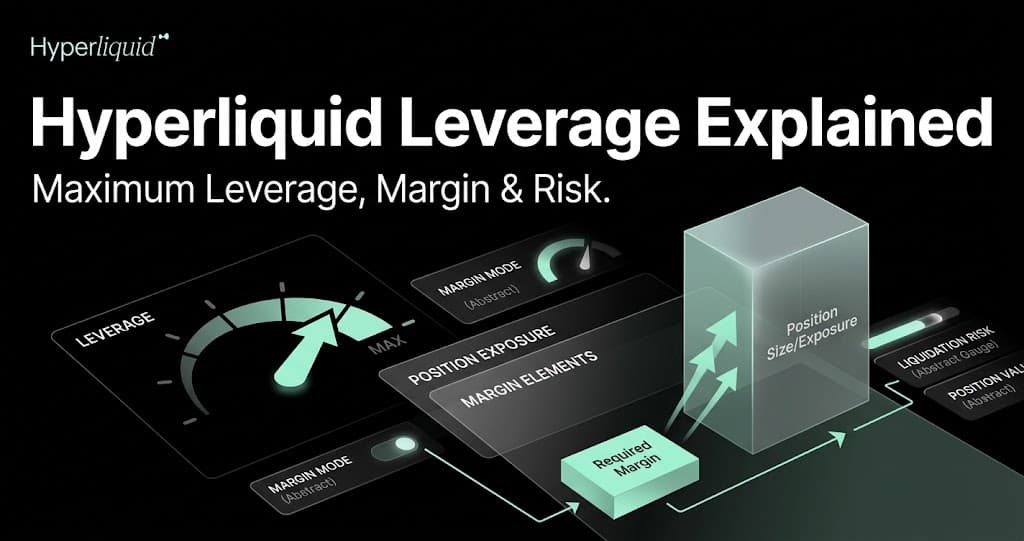
Hyperliquid lets perpetual traders choose leverage from 1x up to a market-specific maximum. Higher leverage reduces the margin needed to open the same position, but it does not reduce the position's dollar exposure, trading fees, funding or loss risk.
Direct answer
How does leverage work on Hyperliquid?
Hyperliquid leverage controls the initial margin required to open a perpetual position. The basic calculation is position notional divided by selected leverage. A $10,000 position therefore requires about $2,000 at 5x or $500 at 20x before fees and other requirements. Each market has its own maximum, large positions may move into lower-leverage margin tiers, and higher leverage leaves less equity available to absorb losses.
Updated 11 Sept 2026
On this page
- What does leverage mean on Hyperliquid?
- How is Hyperliquid margin calculated?
- What is the maximum leverage on Hyperliquid?
- Why can maximum leverage fall for a large position?
- How does leverage differ between cross and isolated margin?
- What is the difference between selected and effective leverage?
- Can you change leverage after opening a Hyperliquid position?
- Does higher leverage increase Hyperliquid fees or funding?
- How does leverage affect liquidation risk?
- How should a beginner choose leverage on Hyperliquid?
- Which Hyperliquid leverage mistakes should you avoid?
Leverage lets a trader control a perpetual position whose notional value is larger than the margin committed to open it. It changes how much collateral the position initially requires. It does not make the market move faster, improve the entry price or turn a risky position into a safer one.
On Hyperliquid, a user can select an integer leverage level from 1x to the maximum permitted for that market. The maximum is not one universal number. It can differ by asset, perpetual DEX and position-size tier, so the live order panel and market metadata matter more than an old screenshot or a general claim about the platform.
What does leverage mean on Hyperliquid?
Leverage compares a position's notional value with the margin assigned to support it. A $10,000 position backed by $2,000 of opening margin uses 5x leverage. The same position backed by $1,000 uses 10x. The market exposure remains $10,000 in both cases.
| Selected leverage | Calculation | Approximate opening margin |
|---|---|---|
| 1x | $10,000 ÷ 1 | $10,000 |
| 2x | $10,000 ÷ 2 | $5,000 |
| 5x | $10,000 ÷ 5 | $2,000 |
| 10x | $10,000 ÷ 10 | $1,000 |
| 20x | $10,000 ÷ 20 | $500 |
The table isolates the initial-margin calculation. A real account must also satisfy maintenance margin and any transfer or tier rules. Trading fees, funding payments, unrealized profit and loss, and activity in other cross positions can change the amount of equity that remains available.
How is Hyperliquid margin calculated?
Hyperliquid documents the opening-margin formula as position size multiplied by mark price, divided by selected leverage. Position size multiplied by mark price is the position's notional value, so the shorter version is: required initial margin = position notional ÷ leverage.
Suppose a trader buys 2 ETH perpetual contracts when the mark price is $3,000. The position notional is $6,000. At 3x leverage, the basic initial-margin requirement is $2,000. At 10x, it is $600. A 4% move against either position creates roughly $240 of unrealized loss before funding and fees because both positions have the same $6,000 exposure.
What is the maximum leverage on Hyperliquid?
There is no single maximum that applies to every Hyperliquid perpetual. Each market's metadata contains a maxLeverage value, and some markets use margin tables that lower the permitted leverage when position notional crosses a stated threshold. A market may also be isolated-only or use stricter rules than another market.
This is why search results describing Hyperliquid as a fixed 40x or 50x platform can be misleading. Those numbers may describe a particular market, an API example or an earlier configuration. They do not establish the limit for the asset and position size a trader is viewing now.
How to check a market's current leverage limit
Choose the exact perpetual market
Confirm both the ticker and the perpetual DEX. A validator-operated market and a similarly named HIP-3 market may not share the same configuration.
Open the leverage and margin control
Use the control shown for the selected market in the official trading interface. The highest permitted setting is the relevant live ceiling for a normal order at that size.
Check whether the market is isolated-only
Some markets do not allow cross margin. Strict isolated markets can also prevent margin from being manually removed after it is assigned.
Account for the position-size tier
A large order can be rejected at the current leverage if the resulting notional belongs to a tier with a lower maximum. Reduce the position, reduce leverage or inspect the market's margin table.
Developers can retrieve the same structure through Hyperliquid's public Info endpoint. The meta response lists each market's maxLeverage and margin-table identifier, while the associated margin table defines any notional thresholds. For most traders, the official interface is the simpler final check.
Why can maximum leverage fall for a large position?
Margin tiers limit how much leverage can be used as position notional grows. A smaller position may qualify for the first tier, while a much larger position in the same market may be restricted to a lower maximum. This increases the equity required behind concentrated exposure.
Hyperliquid calculates tiered maintenance margin as notional position value multiplied by the tier's maintenance-margin rate, minus a maintenance deduction. The deduction keeps the requirement continuous at tier boundaries. The exact lower bounds and leverage levels come from the live margin table rather than a site-wide rule.
An error saying that an order exceeds a margin-tier limit at the current leverage does not necessarily mean the account is broken. It can mean the proposed position would enter a tier whose maximum is below the selected setting. Check total position notional after the order, not only the size of that one order.
How does leverage differ between cross and isolated margin?
| Area | Cross margin | Isolated margin |
|---|---|---|
| Collateral pool | Shares eligible account equity with other cross positions | Uses margin assigned to that position |
| Capital efficiency | Profit and available equity elsewhere can support the position | Unused account equity does not automatically support it |
| Risk connection | A loss can consume equity supporting other cross positions | Loss is contained to the assigned isolated pool |
| Changing margin | Deposit collateral or change account exposure | Margin can normally be added or removed, subject to requirements |
| Liquidation calculation | Uses shared account value and all relevant cross requirements | Uses that position's isolated margin and notional |
Cross is the default standard margin mode. It can use collateral more efficiently, but positions are connected through shared equity. A profitable cross position can support a losing one, while a large loss or funding debit can reduce the buffer for every position in the same cross pool.
Isolated margin confines the supporting collateral to one position. That separation makes the maximum amount assigned to the trade easier to see, but it does not guarantee a fill, prevent slippage or make high leverage safe. The isolated margin can still be lost.
What is the difference between selected and effective leverage?
Selected leverage is the setting used for the order's initial-margin requirement. Effective leverage describes the exposure relative to the equity actually supporting it. They can differ, especially in a cross account with unused collateral or several open positions.
A trader may select 20x for a $10,000 cross position while holding $5,000 of account equity and no other exposure. The order may reserve margin using the 20x setting, but the account is not economically exposed in the same way as a position backed by only $500. Looking only at the selector can overstate or understate the account's real leverage.
A simple single-position estimate is position notional divided by supporting equity. For a multi-position cross account, assess total notional, direction, unrealized profit and loss, collateral and maintenance requirements together. Opposing positions may reduce directional exposure without removing funding, basis, execution or liquidation risk.
Can you change leverage after opening a Hyperliquid position?
Hyperliquid supports updating leverage without closing an existing position, subject to that market's constraints and the account having enough margin. The documentation notes that leverage is checked when a position is opened and that an existing position's leverage can be increased. Traders remain responsible for monitoring margin use afterward.
For isolated positions, adding margin increases the buffer and removing margin reduces it. A removal can fail when the remaining amount would not satisfy the required margin. Strict isolated markets do not allow margin to be removed manually; margin is released proportionally as the position closes.
For cross positions, changing the displayed leverage setting by itself does not add funds to the account or shrink the position. To reduce real exposure, reduce the position notional. To increase the account buffer, add eligible collateral. Treat those actions separately from moving a leverage slider.
Does higher leverage increase Hyperliquid fees or funding?
Trading fees are based on filled notional and the account's applicable maker or taker rate, not merely the dollars posted as margin. Funding payments are also based on position notional and the funding rate. Two traders holding equal-sized positions can therefore face similar dollar fees and funding even if one selected higher leverage and committed less opening margin.
Leverage can still change how large those costs feel. A $5 fee is 0.5% of $1,000 in margin but 1% of $500. Repeated trading, crossing the spread, slippage and hourly funding can consume a thin equity buffer faster than a simple price-only example suggests.
How does leverage affect liquidation risk?
A position becomes liquidatable when its relevant equity falls below maintenance margin. Higher leverage usually means less opening margin supports the same notional, leaving less room for an adverse move. Hyperliquid uses mark price for this calculation rather than relying only on the latest trade.
Maintenance margin is tied to the market's maximum initial leverage and any applicable position tier. It is not simply the leverage selected by the user. Funding payments, losses elsewhere in a cross account, margin transfers and tier changes can move the displayed liquidation estimate after entry.
A stop loss should sit before liquidation if it is part of the plan, but it is not a guarantee. A market stop can slip during a fast move, while a stop-limit can trigger without filling. Position size and available liquidity remain important even when an exit order is already placed.
How should a beginner choose leverage on Hyperliquid?
There is no universally safe leverage number. Start from the maximum dollar loss the account can tolerate, choose an invalidation or exit level, and size the position from that risk. Leverage should be the final financing setting, not the starting reason for making the trade larger.
A leverage check before submitting an order
Set the loss limit in dollars
Choose the amount the account can lose on the idea without affecting essential funds or the ability to follow the wider plan.
Define where the trade is wrong
Use a market-based exit level rather than selecting a position from the maximum leverage available.
Calculate position notional
Estimate size from the distance to the exit and include room for slippage, fees and funding rather than treating the stop price as a guaranteed fill.
Choose cross or isolated deliberately
Decide whether the position should share account equity or remain limited to its assigned margin pool.
Use enough margin
Select leverage that leaves a meaningful buffer before liquidation. Maximum available leverage is a technical ceiling, not a recommendation.
Review the live order summary
Confirm market, side, size, estimated fill, margin mode, leverage, liquidation estimate and exits before signing.
Which Hyperliquid leverage mistakes should you avoid?
- Assuming one maximum-leverage number applies to every market
- Using the leverage selector as a position-sizing tool
- Confusing lower opening margin with lower dollar exposure
- Ignoring margin tiers when building a large position through several orders
- Believing a lower cross leverage setting automatically moves an existing liquidation price
- Treating isolated margin as protection from slippage or a guaranteed loss cap
- Calculating fees and funding from posted margin instead of position notional
- Watching last price while ignoring the mark price used for margining
- Placing an exit too close to liquidation to allow for normal volatility and execution
Frequently asked questions
What is the maximum leverage on Hyperliquid?
Hyperliquid does not have one maximum for every perpetual. Maximum leverage is stored per market and may fall at larger position-size tiers. Check the selected market's live leverage control or current meta and margin-table data before trading.
Does Hyperliquid offer 50x leverage?
A 50x value can appear for particular market configurations or in official API examples, but it should not be treated as a platform-wide promise. The live maximum depends on the exact market, perpetual DEX and position tier.
How much margin does a 10x Hyperliquid position require?
The basic opening requirement is position notional divided by 10. A $10,000 position therefore requires about $1,000 of initial margin before fees, funding and any additional account or tier requirements.
Can I trade Hyperliquid with 1x leverage?
Yes, when the selected perpetual market permits the order. A 1x perpetual still remains a derivative with trading fees, funding, mark-price margining and execution risk; it is not the same as owning the spot asset.
Is isolated leverage safer than cross leverage?
Isolated margin limits the position to its assigned collateral pool, while cross margin shares eligible account equity. Isolation contains the affected pool but does not prevent the assigned margin from being lost or guarantee execution.
Does changing cross leverage change liquidation price?
Not by itself after the cross position is open. Hyperliquid states that actual cross liquidation price is independent of the selected leverage setting. Position size, account equity, maintenance margin, funding and other cross positions determine the threshold.
Why was my Hyperliquid order rejected at the current leverage?
The account may lack initial margin, the order may push total position notional into a lower-leverage margin tier, or the market may have a lower maximum than the selected setting. Read the exact error and check the live margin table.
Does leverage multiply Hyperliquid trading fees?
Fees are charged from filled notional using the applicable maker or taker rate. Leverage does not directly multiply the rate, but it lets a trader create more notional from the same margin, which can increase total dollar fees.
Does leverage affect Hyperliquid funding payments?
Funding is calculated from position notional and the applicable funding rate, not only the posted margin. Higher leverage can make the same funding payment larger relative to the equity supporting the position.
Can you change Hyperliquid leverage without closing a position?
Hyperliquid supports updating leverage subject to the market limit and margin constraints. Changing a setting does not reduce position notional; reduce or close exposure if the goal is to lower the dollars at risk.
Sources
- Hyperliquid documentation - Margining↗ external
- Hyperliquid documentation - Margin tiers↗ external
- Hyperliquid documentation - Perpetual assets↗ external
- Hyperliquid documentation - Contract specifications↗ external
- Hyperliquid documentation - Liquidations↗ external
- Hyperliquid documentation - Perpetuals Info endpoint↗ external
- Hyperliquid documentation - Exchange endpoint↗ external
- Hyperliquid documentation - Account abstraction modes↗ external