Hyperliquid Liquidation Explained: Price, Leverage and Margin
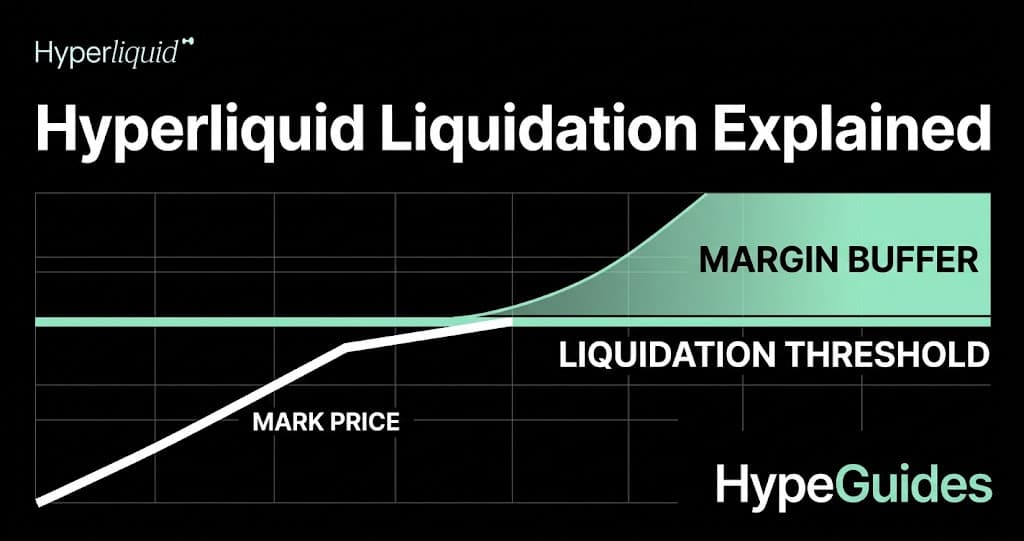
A Hyperliquid perpetual position becomes liquidatable when its supporting equity falls below the required maintenance margin. The mark price—not simply the latest trade—determines when that threshold is reached.
Direct answer
How does liquidation work on Hyperliquid?
Hyperliquid liquidates a perpetual position when the relevant account or isolated-position equity falls below its maintenance-margin requirement. Liquidations use the mark price. The system first sends a market liquidation order to the order book; if equity falls below two-thirds of maintenance margin without a successful book liquidation, the liquidator vault can take over the position.
Updated 23 Aug 2026
On this page
- What causes a liquidation on Hyperliquid?
- Does Hyperliquid use mark price for liquidations?
- What is Hyperliquid maintenance margin?
- What is the Hyperliquid liquidation price formula?
- Worked isolated-margin example
- How does leverage affect Hyperliquid liquidation price?
- What is the difference between cross and isolated liquidation?
- Why can the displayed liquidation price change?
- What happens when Hyperliquid liquidates a position?
- How can traders reduce liquidation risk?
- Which Hyperliquid liquidation mistakes should you avoid?
Liquidation is a forced reduction or closure of a leveraged perpetual position after the collateral supporting it is no longer sufficient. It is not triggered merely because a position is losing money. The decisive test is whether the relevant equity still covers Hyperliquid's maintenance-margin requirement.
What causes a liquidation on Hyperliquid?
For a standard cross-margin account, liquidation begins when account value, including unrealized profit and loss, falls below the maintenance margin required by all open cross positions. For an isolated position, the same test uses only that position's isolated margin, not the rest of the cross account.
| Term | Meaning | Why it matters |
|---|---|---|
| Account or position equity | Collateral plus applicable unrealized profit and loss | The funds available to support the position |
| Position notional | Position size multiplied by mark price | Larger notional creates a larger margin requirement |
| Maintenance margin | Minimum equity required to keep the position open | Falling below it makes the position liquidatable |
| Mark price | Robust reference used for margining and unrealized PnL | It—not the last trade—drives the liquidation test |
Does Hyperliquid use mark price for liquidations?
Yes. Hyperliquid uses mark price for margining, liquidations, unrealized profit and loss, and TP/SL triggers. A temporary last trade does not by itself set the liquidation threshold. Mark price is designed to be a more robust estimate of fair perpetual value than one instantaneous execution price.
The documented mark-price calculation takes the median of several inputs. These include an oracle-based price adjusted by a 150-second moving average of Hyperliquid's basis, Hyperliquid book and last-trade data, and a weighted median of perpetual mid-prices from major external exchanges. Validators update mark and oracle prices approximately every three seconds.
Mark price and book price can diverge during fast markets. A stop triggered by mark price still has to execute against available order-book liquidity, so the trigger price, liquidation threshold and eventual fill price should not be assumed to be identical.
What is Hyperliquid maintenance margin?
Maintenance margin is the minimum equity that must remain behind a perpetual position. Hyperliquid currently sets the maintenance-margin rate at half of the initial-margin rate required at an asset's maximum leverage. Because maximum leverage varies by asset, the maintenance requirement also varies by asset.
| Asset maximum leverage | Initial margin at maximum | Maintenance-margin rate |
|---|---|---|
| 40x | 2.5% | 1.25% |
| 20x | 5% | 2.5% |
| 10x | 10% | 5% |
| 3x | 33.3% | 16.7% |
Hyperliquid's current liquidation documentation describes asset maximums ranging from 3x to 40x. These values and individual market limits can change, so check the current market interface or official metadata instead of assuming that every asset supports the same leverage.
Large positions may also enter margin tiers. For a tiered position, maintenance margin equals notional position value multiplied by the tier's maintenance-margin rate, minus its maintenance deduction. The deduction keeps the requirement continuous as a position crosses tier boundaries.
What is the Hyperliquid liquidation price formula?
Hyperliquid documents the precise standard-margin formula as: liquidation price = price - side × margin available ÷ position size ÷ (1 - maintenance-margin fraction × side).
| Variable | Definition |
|---|---|
| Price | The current mark price used with the current account state |
| Side | +1 for a long position and -1 for a short position |
| Position size | Absolute contract quantity expressed in units of the underlying asset |
| Maintenance-margin fraction | 1 divided by maintenance leverage; tier-specific for positions subject to margin tiers |
| Margin available, cross | Account value minus total maintenance margin required |
| Margin available, isolated | Isolated margin minus that position's maintenance margin required |
The denominator matters because the maintenance requirement itself changes with position value as price changes. A shortcut such as entry price minus entry price divided by leverage ignores maintenance margin, account equity, funding and cross-position effects. It may be directionally useful, but it is not Hyperliquid's exact formula.
Worked isolated-margin example
Assume an illustrative market with 20x maximum leverage, which implies a 2.5% maintenance-margin rate. A trader opens 10 contracts at $1,000, creating $10,000 of notional, and assigns $1,000 of isolated margin for effective 10x leverage. At entry, maintenance margin is $250 and margin available above maintenance is $750.
| Position | Calculation | Approximate liquidation price |
|---|---|---|
| Long | $1,000 - ($750 ÷ 10 ÷ 0.975) | $923.08 |
| Short | $1,000 + ($750 ÷ 10 ÷ 1.025) | $1,073.17 |
How does leverage affect Hyperliquid liquidation price?
Higher leverage means less initial margin supports the same position notional. That generally leaves a smaller buffer between entry and liquidation. Hyperliquid calculates the margin required to open a position as position size multiplied by mark price, divided by the selected leverage.
The effect of the leverage setting differs between margin modes. For isolated margin, the chosen leverage determines the initial margin allocated to that position, so it directly affects liquidation price. For cross margin, Hyperliquid states that the actual liquidation price is independent of the leverage setting after the position is open: cross positions draw on shared account value, while the setting controls the initial margin check when the trade is placed.
| Margin mode | What backs the position | Does selected leverage affect liquidation price? |
|---|---|---|
| Cross | Shared eligible account equity | Not directly after opening; shared equity and all cross requirements determine the threshold |
| Isolated | Margin assigned to that position | Yes; selected leverage determines the initial isolated margin allocation |
What is the difference between cross and isolated liquidation?
Cross margin pools collateral across cross positions, improving capital efficiency but linking their risk. Profit on one cross position can support a loss elsewhere, while a losing position can consume equity that supports the rest of the account. A cross liquidation therefore depends on the combined account state, not one position viewed alone.
Isolated margin confines the calculation to one position and its assigned collateral. A liquidation in that isolated position does not affect other isolated positions or standard cross positions. Isolation limits the pool exposed to that trade, but it does not guarantee a particular fill or prevent the assigned margin from being lost.
Why can the displayed liquidation price change?
- Funding debits or credits change the balance supporting an open perpetual position.
- Unrealized profit or loss on another cross position changes shared account equity.
- Depositing collateral, withdrawing it or transferring isolated margin changes margin available.
- Increasing, reducing or reversing a position changes notional and maintenance requirements.
- A larger position can enter a different margin tier with a different maintenance rate.
- Before entry, changing order-book liquidity can alter the estimated fill and therefore the estimated liquidation price.
What happens when Hyperliquid liquidates a position?
The documented liquidation sequence
Equity crosses maintenance margin
The mark-price-based margin calculation determines that the account or isolated position is liquidatable.
A market liquidation order reaches the book
Hyperliquid first attempts to close enough of the position through its onchain order book. If the requirement is restored, the trader keeps remaining collateral.
Large positions may be reduced partially
For liquidatable mainnet positions above $100,000 notional, the documented process initially sends 20% as a market liquidation order. A 30-second cooldown follows a partial liquidation.
The liquidator vault provides a backstop
If equity falls below two-thirds of maintenance margin without a successful book liquidation, the liquidator vault can take over the position and applicable margin.
Hyperliquid states that it does not charge a separate clearance fee on liquidations. That does not make liquidation costless: forced market execution can create slippage, ordinary fill-related costs may apply, and maintenance margin is not returned during a backstop liquidation.
In a cross backstop liquidation, all cross positions and cross margin are transferred to the liquidator. In an isolated backstop liquidation, only that isolated position and its margin are transferred; the user's cross account and other isolated positions remain separate.
How can traders reduce liquidation risk?
A pre-trade liquidation check
Reduce position notional
Position size is the most direct risk control. A smaller position uses less maintenance margin and loses fewer dollars for the same percentage move.
Choose margin mode deliberately
Use isolated margin when the goal is to confine one trade's collateral. Use cross only after understanding that positions share account equity.
Keep distance from liquidation
Do not treat the liquidation price as a stop. Plan an earlier exit that leaves room for volatility, mark-to-book differences and execution slippage.
Monitor funding and the whole account
Funding debits and losses elsewhere can reduce the buffer even when the position's market price has barely moved.
Act before the threshold
Possible actions include reducing or closing the position, adding isolated margin, or depositing collateral into a cross account. Waiting until liquidation removes control over execution.
Hyperliquid TP/SL orders trigger from mark price. A market stop prioritizes execution but can slip; a stop-limit constrains the execution price but may remain unfilled during a fast move. Neither type guarantees an exit before liquidation in every market condition.
Which Hyperliquid liquidation mistakes should you avoid?
- Watching the last-traded price while ignoring the mark price used for margining
- Treating the displayed liquidation estimate as a guaranteed fill price
- Using entry price divided by leverage as if it were the exact formula
- Assuming lower selected leverage changes an existing cross liquidation threshold by itself
- Ignoring other cross positions that draw on the same account equity
- Forgetting that funding payments can move the liquidation threshold
- Using a stop-limit so tight that it may trigger without filling
- Adding collateral to rescue an oversized position without reassessing the original risk
Frequently asked questions
At what price does Hyperliquid liquidate a position?
Hyperliquid liquidates when mark-price-based equity falls below maintenance margin. The displayed liquidation price estimates where that condition occurs, but funding, other cross positions, margin changes and margin tiers can move the actual threshold.
Does Hyperliquid use mark price or last price for liquidation?
Hyperliquid uses mark price for margining and liquidations. Mark price combines several market and oracle-based inputs, so it can differ from the latest trade or current order-book price.
What is the Hyperliquid liquidation price formula?
The documented standard-margin formula is liquidation price = price - side × margin available ÷ position size ÷ (1 - maintenance-margin fraction × side), where side is +1 for a long and -1 for a short.
Does higher leverage increase liquidation risk on Hyperliquid?
Yes. Higher leverage allows the same notional position to be opened with less initial margin, leaving less room for adverse movement. For isolated margin, selected leverage directly affects allocated margin and liquidation price.
Does changing leverage move a cross-margin liquidation price?
Not by itself after the cross position is open. Hyperliquid states that actual cross liquidation price is independent of the selected leverage because all cross positions use shared account value. Changing position size or account equity can still move the threshold.
Can funding payments cause liquidation?
Funding debits reduce the balance supporting a position and can move it closer to liquidation. Funding credits increase equity, but they do not remove market, leverage or execution risk.
Does Hyperliquid charge a liquidation fee?
Hyperliquid's documentation says there is no separate clearance fee on liquidations. Forced market execution can still involve slippage and fill-related costs, and maintenance margin is not returned in a backstop liquidation.
What happens to remaining collateral after liquidation?
If an order-book liquidation closes enough exposure to restore the maintenance requirement, remaining collateral stays with the trader. During a backstop liquidation, the applicable maintenance margin is not returned.
Is isolated margin safer than cross margin?
Isolated margin limits a position to its assigned collateral and separates it from other cross and isolated positions. That contains the affected pool, but the isolated margin can still be lost and execution can still slip.
Can a stop loss guarantee that I avoid liquidation?
No. A market stop can experience slippage, while a stop-limit may trigger without filling. Placing an exit well before the liquidation threshold can reduce risk, but no conditional order guarantees execution in every market condition.
Sources
- Hyperliquid documentation - Liquidations↗ external
- Hyperliquid documentation - Margining↗ external
- Hyperliquid documentation - Margin tiers↗ external
- Hyperliquid documentation - Robust price indices↗ external
- Hyperliquid documentation - Contract specifications↗ external
- Hyperliquid documentation - TP/SL orders↗ external
- Hyperliquid documentation - Portfolio margin↗ external