Hyperliquid Vaults Explained: HLP, Fees, Returns and Risks
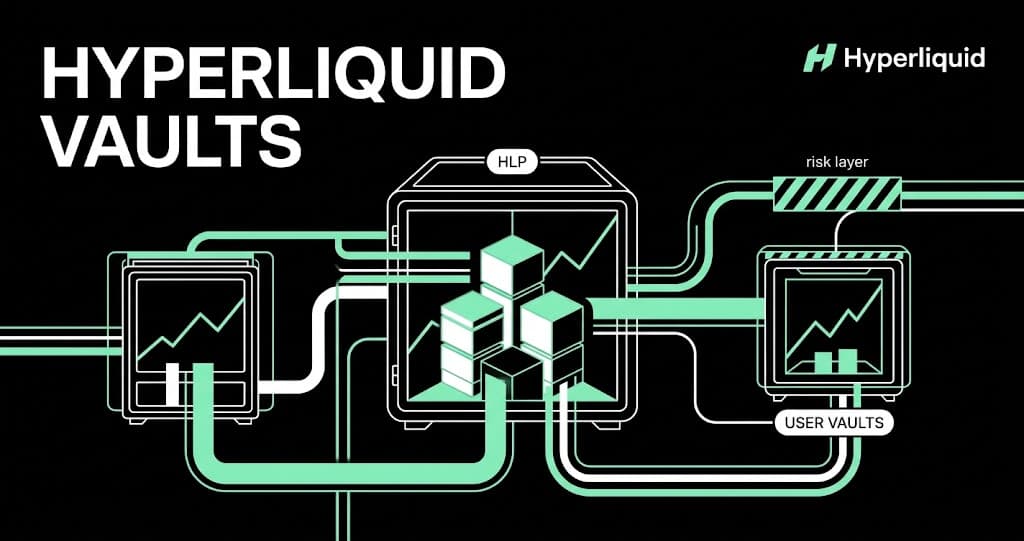
Hyperliquid vaults pool depositor capital into onchain trading strategies. HLP is a protocol vault, while legacy user vaults are managed by individual leaders or automated strategies. Depositors share the resulting gains and losses.
Direct answer
What are Hyperliquid vaults?
Hyperliquid vaults are pooled accounts on HyperCore that use depositor funds in trading strategies. HLP is the community-owned protocol vault used for market making, liquidations, supplying USDC in Earn and receiving part of platform fees. Legacy user vaults are leader-managed strategies whose owners receive 10% of profits. Neither type offers a guaranteed return.
Updated 4 Sept 2026
On this page
- How do Hyperliquid vaults work?
- What is the difference between HLP and user vaults?
- What is the Hyperliquidity Provider (HLP) vault?
- How do Hyperliquid user vaults work?
- Is the Hyperliquid vault performance fee 10%?
- What does Hyperliquid vault APY mean?
- What fees and costs apply to Hyperliquid vaults?
- How long are Hyperliquid vault withdrawals locked?
- Are Hyperliquid vaults the same as copy trading?
- What should you check before depositing into a Hyperliquid vault?
- What are the main risks of Hyperliquid vaults?
A Hyperliquid vault lets many depositors allocate capital to one onchain trading account. The vault's strategy places trades and its equity changes with realized profit, unrealized profit and loss, fees, funding and any costs created when positions must be closed. A depositor owns a proportional claim on that changing equity rather than a fixed-interest balance.
There are two important categories. Hyperliquidity Provider, or HLP, is a protocol vault with defined roles in the Hyperliquid system. User-managed HyperCore vaults allow an individual leader or automated strategy to trade pooled funds. Hyperliquid's current documentation labels the user-vault system as legacy and says more advanced vault features should be built permissionlessly on HyperEVM.
How do Hyperliquid vaults work?
From deposit to withdrawal
A depositor selects a vault
The vault page shows its address, strategy information, historical performance, total deposits, positions and other available records.
Capital joins the pooled account
The deposit buys a proportional claim on the vault's equity. It is no longer an idle balance controlled as a separate personal trade.
The strategy trades
HLP follows protocol strategies. A legacy user vault follows the decisions of its leader or automated manager within the products that vault can access.
Vault equity changes
Profits increase the depositor's share value and losses reduce it. Trading fees, funding, commissions and closing costs can affect the final result.
The depositor withdraws after the lockup
The amount returned depends on current vault equity and any applicable profit share or position-closing cost, not simply the original deposit.
What is the difference between HLP and user vaults?
| Area | HLP | Legacy user vault |
|---|---|---|
| Operator | Protocol strategies | Individual leader or automated manager |
| Main role | Market making, liquidations, USDC supply in Earn and fee accrual | Runs a selected trading strategy for depositors |
| Profit share | No vault-owner fee or profit share | Leader receives 10% of profits |
| Deposit lockup | 4 days | 1 day |
| Market access | Defined by HLP's protocol strategies | Validator-operated perpetuals; no spot or HIP-3 perps under legacy rules |
| Main diligence question | How HLP's combined strategies behave in stressed markets | Who operates the vault and what its history reveals about the strategy |
The distinction matters because a strong result from one category says little about another. HLP is not a copy of a featured trader, and a user vault is not backed by the same mix of protocol activities as HLP. Evaluate the exact vault address and current page rather than relying on the word vault alone.
What is the Hyperliquidity Provider (HLP) vault?
Hyperliquid describes HLP as a fully community-owned protocol vault. It provides liquidity through multiple market-making strategies, performs liquidations, supplies USDC in HyperCore Earn and accrues a portion of trading fees. Depositors share the combined profit and loss produced by those activities.
HLP's liquidator component can take over positions during a backstop liquidation when an undercollateralized account falls below the documented threshold and an order-book liquidation has not succeeded. Hyperliquid states that backstop liquidations are profitable for the liquidator on average. On average is not the same as always: inherited positions still need to be managed or exited during potentially fast and illiquid markets.
| Activity | Potential positive contribution | Main risk |
|---|---|---|
| Market making | Spread capture, maker economics and inventory management | Adverse selection, inventory losses and volatile price moves |
| Backstop liquidations | Taking over positions at a maintenance-margin buffer | Losses while inherited exposure is being unwound |
| USDC supplied in Earn | Interest paid by borrowers | Utilization, collateral, liquidation and system risk |
| Share of platform fees | Revenue generated by eligible trading activity | Fee income may vary with volume and protocol rules |
How do Hyperliquid user vaults work?
A legacy user vault is controlled by a vault leader who trades on behalf of the pooled account. The leader can be a person following a discretionary process or an automated market-making strategy. Depositors do not approve each order, so their result depends on decisions made at the vault level.
Under the current legacy documentation, creating a user vault requires the leader to deposit at least 100 USDC, pay a 100 USDC creation charge and maintain at least 5% ownership. Those conditions give the leader some capital exposure, but they do not prove skill, control leverage or guarantee that the leader's incentives match every depositor's risk tolerance.
Legacy user vaults can trade validator-operated perpetual markets but cannot trade spot or HIP-3 perpetuals. Because the documentation now labels this system legacy, traders should verify product access and the vault's current status in the live interface before depositing.
Is the Hyperliquid vault performance fee 10%?
For legacy user vaults, yes: Hyperliquid's documentation says the vault owner receives 10% of total profits. It describes this as a profit share. Protocol vaults such as HLP do not have a vault-owner fee or profit share under the same documentation.
The 10% is applied to profit, not to the full deposit. In a simplified example, if a depositor's 1,000 USDC share grows to 1,100 USDC, the gross profit is 100 USDC. A 10% leader share of that profit is 10 USDC, leaving 1,090 USDC before any closing cost or other adjustment. If the share falls to 900 USDC, the depositor bears the loss; a 10% share of the original 1,000 USDC is not charged merely for withdrawing.
What does Hyperliquid vault APY mean?
A displayed vault APY annualizes historical performance. It is a backward-looking presentation of what happened over a selected period, not a rate promised for the next year. A short profitable interval can produce an unusually high annualized figure even when the strategy has little history or later gives back its gains.
Read APY with the equity curve, maximum drawdown, age, deposits, withdrawals, volume, open positions and trade history. Also ask whether a recent result came from repeatable activity or one concentrated position. Two vaults with the same displayed APY can have very different leverage, volatility and downside paths.
- APY does not show the order in which gains and losses occurred.
- APY can change sharply when the measurement window or vault equity changes.
- A smooth history can hide open risk that has not yet become realized PnL.
- A new vault has less evidence across different market conditions.
- Past performance does not guarantee a positive future withdrawal value.
What fees and costs apply to Hyperliquid vaults?
| Cost | HLP | Legacy user vault |
|---|---|---|
| Leader profit share | None | 10% of profits |
| Underlying trading fees | Reflected in strategy PnL | Reflected in strategy PnL |
| Funding and execution | Can affect positions and returns | Can affect positions and returns |
| Withdrawal closing cost | Can depend on current positions and implementation | Can arise when positions must be reduced to release margin |
| Flat 1 USDC bridge withdrawal fee | Not the vault withdrawal fee | Not the vault withdrawal fee |
The official vault depositor documentation does not describe a universal flat vault-withdrawal charge. The familiar 1 USDC charge applies when USDC is withdrawn through Hyperliquid's native bridge to Arbitrum, which is a separate action after funds have left the vault. A vault withdrawal can instead be affected by profit share and the cost of freeing equity from open positions.
Vault trading volume is treated separately from the depositor's master account for fee-tier purposes. Depositing into a high-volume vault does not give the personal trading account the vault's fee tier, and the personal account's referral discount should not be assumed to reduce the vault's trading costs.
How long are Hyperliquid vault withdrawals locked?
HLP has a four-day deposit lockup. The protocol-vault documentation defines this as four days after the most recent deposit, so adding funds changes the relevant withdrawal time. Legacy user vaults have a one-day lockup under the current depositor documentation.
Passing the lockup does not freeze the withdrawal value. Vault equity can rise or fall while a request is unavailable, and available margin may depend on open positions. If a legacy user vault lacks enough margin for a withdrawal, the documented process can cancel margin-using orders and close 20% portions of positions until enough margin is released. A leader can also choose proportional position closure on withdrawals.
Are Hyperliquid vaults the same as copy trading?
Not exactly. In account-level copy trading, a follower usually receives separate trades in a personal account and may control position sizing or exits. A HyperCore vault pools capital in one vault account. The leader or protocol strategy trades that pooled equity, while depositors own claims on the vault rather than matching positions in their own accounts.
A user vault can resemble copy trading economically because depositors rely on a leader's decisions, but the operating model and withdrawal mechanics differ. HLP is further removed from copy trading because it combines protocol strategies rather than mirroring one public trader.
What should you check before depositing into a Hyperliquid vault?
Vault due-diligence checklist
Identify the exact vault type and address
Confirm whether it is HLP, a legacy user vault or a separate HyperEVM product. Similar names do not create the same rules or risks.
Read the strategy and operator history
For a user vault, investigate who controls it and whether the description matches its actual positions and trades.
Inspect more than APY
Review equity history, drawdown, vault age, total deposits, open positions, leverage, volume and concentration.
Calculate fees and the withdrawal window
Separate user-vault profit share, underlying trading costs, possible closing cost and any later bridge fee.
Model a loss scenario
Estimate the result if the largest open position moves sharply, liquidity weakens or the historical drawdown is exceeded.
Start with an amount that can remain locked
Do not deposit funds needed before the lockup expires, and assume the amount available afterward could be lower.
What are the main risks of Hyperliquid vaults?
- Strategy risk - the trades may lose money even if the vault previously performed well.
- Leverage and liquidation risk - perpetual positions can be force-closed when equity falls below maintenance margin.
- Leader risk - a user-vault manager can change positions or take risks a depositor did not expect.
- Market-making risk - spread income can be outweighed by inventory losses and adverse selection.
- Withdrawal risk - lockups and open-position closing costs can limit the timing and value of an exit.
- Concentration risk - one market, position or event can dominate a vault's result.
- Protocol and network risk - HyperCore, its interfaces and connected systems can experience bugs or disruption.
- Stablecoin risk - USDC-denominated equity remains exposed to issuer, market and access risks.
- Measurement risk - annualized APY and short histories can make a strategy look more stable than it is.
- Legacy-product risk - user-vault rules and availability can change as more vault functionality moves to HyperEVM builders.
Frequently asked questions
What is HLP on Hyperliquid?
HLP stands for Hyperliquidity Provider. It is a community-owned protocol vault that performs market making and liquidations, supplies USDC in Earn, receives part of platform fees and shares the resulting PnL with depositors.
Does the HLP vault charge a 10% performance fee?
No. Hyperliquid's documentation says protocol vaults such as HLP do not have a vault-owner fee or profit share. The 10% profit share applies to legacy user-managed HyperCore vaults.
What is the Hyperliquid user-vault performance fee?
The owner of a legacy user vault receives 10% of total profits under the documented rules. It is a share of profit, not 10% of the full deposit or withdrawal amount.
How long is the HLP withdrawal lockup?
HLP deposits are locked for four days after the most recent deposit. A later deposit changes the relevant four-day withdrawal time.
How long is a Hyperliquid user-vault lockup?
The current legacy user-vault depositor documentation states a one-day lockup. Check the live vault interface because rules and product status can change.
Does Hyperliquid charge a vault withdrawal fee?
The documentation does not describe one universal flat vault-withdrawal fee. A user-vault withdrawal can include its 10% profit share and position-closing costs. The separate 1 USDC fee applies when withdrawing USDC through the native bridge to Arbitrum.
Is Hyperliquid vault APY guaranteed?
No. Displayed APY annualizes historical performance. Future trading, funding, fees, liquidations and market conditions can produce a lower return or a loss.
Can you lose money in the HLP vault?
Yes. HLP is exposed to market making, liquidation, lending, execution, stablecoin and protocol risks. Its strategies may have been profitable over a period without guaranteeing future profits.
Do Hyperliquid vaults count toward my trading fee tier?
Vault volume is treated separately from the master account under Hyperliquid's fee documentation. A depositor should not assume vault activity improves the personal account's rolling fee tier.
Can Hyperliquid user vaults trade spot or HIP-3 markets?
Not under the current legacy HyperCore vault rules. The documentation says these vaults can trade validator-operated perpetuals but not spot or HIP-3 perpetual markets.
Sources
- Hyperliquid documentation - HyperCore vaults (legacy)↗ external
- Hyperliquid documentation - Protocol vaults↗ external
- Hyperliquid documentation - For vault depositors (legacy)↗ external
- Hyperliquid documentation - For vault leaders (legacy)↗ external
- Hyperliquid documentation - Fees↗ external
- Hyperliquid documentation - Liquidations↗ external
- Hyperliquid developer documentation - Vault information↗ external
- Hyperliquid documentation - Portfolio margin and Earn↗ external