Can You Buy Hyperliquid Stock? HYPE and HIP-3 Markets Explained
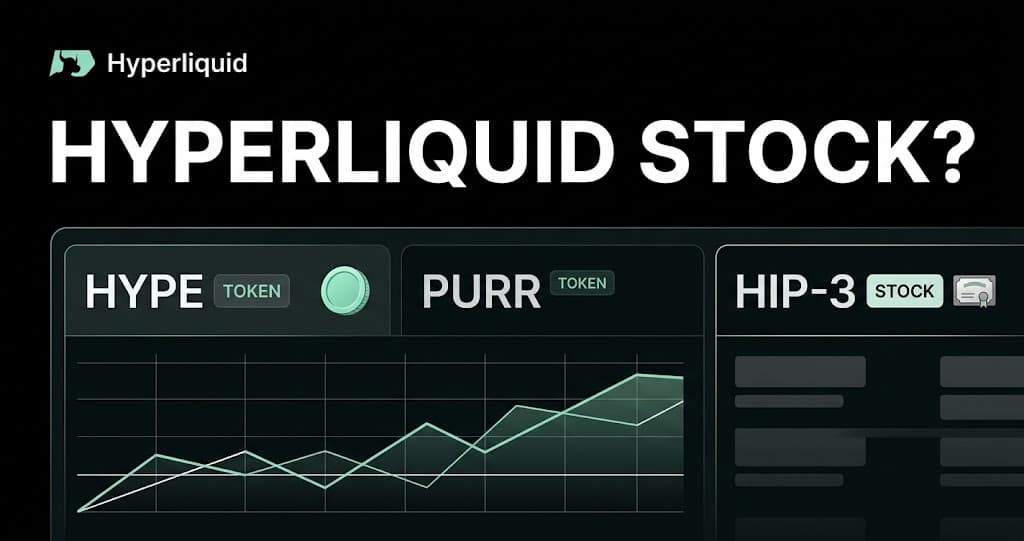
Hyperliquid Labs does not have publicly traded shares or a stock ticker. HYPE is the network's token, PURR and THYP are separate listed products, and HIP-3 stock markets provide derivative exposure without ownership of the underlying shares.
Direct answer
Can you buy Hyperliquid stock?
You cannot buy public shares in Hyperliquid Labs because it has no listed stock ticker. You can instead buy HYPE, the Hyperliquid network's native token; buy separate listed securities such as Hyperliquid Strategies stock (Nasdaq: PURR) or the 21Shares Hyperliquid ETF (Nasdaq: THYP); or trade stock-linked HIP-3 perpetuals on Hyperliquid. None of these represents equity ownership in Hyperliquid Labs.
Updated 21 Oct 2026
On this page
- Is Hyperliquid publicly traded?
- Is HYPE the same as Hyperliquid stock?
- What is Hyperliquid Strategies stock (PURR)?
- What is the THYP Hyperliquid ETF?
- Can you trade stocks on Hyperliquid?
- How do Hyperliquid stock perpetuals work?
- Why does the ticker prefix matter?
- Do Hyperliquid stock markets follow exchange hours?
- Which type of Hyperliquid exposure fits each goal?
- How to verify a Hyperliquid stock market before trading
- What are the main risks?
- What is the bottom line on Hyperliquid stock?
The phrase "Hyperliquid stock" can refer to four different things: shares in the company that contributes to Hyperliquid, the HYPE token, publicly traded products linked to HYPE, or stock-price markets inside the Hyperliquid app. These are not interchangeable. The legal rights, custody, trading venue and risks change depending on which one you buy.
| Product | What it is | What you own |
|---|---|---|
| Hyperliquid Labs shares | Equity in the protocol's software contributor | Not publicly available |
| HYPE | Native digital asset of the Hyperliquid network | A token, not company equity |
| PURR | Common stock in Hyperliquid Strategies Inc | Equity in a separate HYPE treasury company |
| THYP | 21Shares Hyperliquid ETF shares | Shares in a fund holding HYPE |
| HIP-3 stock perpetual | Leveraged derivative tracking a stock-related reference | A contract position, not the underlying shares |
Is Hyperliquid publicly traded?
No public stock ticker represents ownership in Hyperliquid Labs. Hyperliquid Labs is a software development company that contributes to the protocol, while the Hyper Foundation supports the network and ecosystem. A 2026 U.S. securities filing described Hyperliquid Labs as a private development company, and neither the official Hyper Foundation material nor public-market records identify listed Hyperliquid Labs shares.
This means you cannot buy Hyperliquid Labs stock through a normal brokerage account. A company or fund can use the word Hyperliquid in its name or hold HYPE without being the same legal entity as Hyperliquid Labs. Read the issuer name, ticker and prospectus rather than treating similar branding as proof of ownership in the protocol contributor.
Is HYPE the same as Hyperliquid stock?
No. HYPE is the native digital asset of the Hyperliquid network. It is used in network security, staking, governance and HyperEVM gas. The token can gain or lose value as demand, supply and network activity change, but it does not grant shares, a legal ownership percentage, voting rights in a company or a claim on company assets.
Holding HYPE is therefore closer to owning a network asset than buying conventional stock. Token governance and validator delegation are protocol functions, not shareholder votes. Staking rewards are protocol emissions or rewards for network participation, not corporate dividends. The HYPE token guide explains its supply, uses, staking and fee-burning mechanics in more detail.
What is Hyperliquid Strategies stock (PURR)?
Hyperliquid Strategies Inc is a Nasdaq-listed digital-asset treasury company trading under PURR. Its 2026 Form 10-K says its primary business is accumulating HYPE on behalf of stockholders, deploying HYPE in income-producing activities and participating in the Hyperliquid ecosystem. The company also operates a validator in partnership with another organization.
PURR can give a brokerage account indirect exposure to HYPE, but its share price will not necessarily move one-for-one with the token. PURR also reflects the company's HYPE per share, cash, liabilities, operating costs, staking and validator results, management decisions, new share issuance and the premium or discount investors assign to its net assets.
- PURR shareholders own part of Hyperliquid Strategies Inc, not Hyperliquid Labs.
- The company can issue shares, raise capital, buy or sell HYPE and change how it deploys its treasury.
- A rising HYPE price does not guarantee PURR will rise by the same percentage.
- Company-specific risks remain even if the Hyperliquid network performs well.
What is the THYP Hyperliquid ETF?
THYP is the Nasdaq ticker for the 21Shares Hyperliquid ETF. The fund holds HYPE and may stake a portion of its holdings under the terms in its prospectus. Investors buy fund shares through a brokerage account rather than controlling the underlying wallet or staking position themselves.
THYP is not stock in Hyperliquid Labs and is not identical to holding HYPE directly. Fund expenses, market-price premiums or discounts, custody, staking operations and the fund's creation-and-redemption process can make shareholder returns differ from the token's return. The issuer's current factsheet also states that shareholders do not receive all rights associated with owning HYPE directly.
Can you trade stocks on Hyperliquid?
Yes, but you are trading stock-linked perpetual derivatives rather than buying shares. HIP-3 allows qualified third-party deployers to create perpetual markets on HyperCore. The deployer defines the contract, manages its oracle and market operations, selects leverage and can halt or settle the market within protocol rules.
Hyperliquid's official API classified 129 active entries as stock or stocks when checked on October 21, 2026. That count includes exchange-traded funds, non-U.S. listings and duplicate exposure offered by different HIP-3 deployers, so it should not be read as 129 unique public companies. Three additional active markets were tagged pre-IPO.
| Displayed ticker | Full market ID | Reference | Maximum leverage |
|---|---|---|---|
| AAPL | xyz:AAPL | Apple share price | 20x |
| NVDA | xyz:NVDA | Nvidia share price | 20x |
| TSLA | xyz:TSLA | Tesla share price | 20x |
| MSFT | xyz:MSFT | Microsoft share price | 20x |
| GOOGL | xyz:GOOGL | Alphabet share price | 20x |
| AMZN | xyz:AMZN | Amazon share price | 20x |
| MU | xyz:MU | Micron share price | 10x |
How do Hyperliquid stock perpetuals work?
A perpetual contract tracks a reference price without delivering the underlying share and has no scheduled expiry. You post the collateral required by that HIP-3 DEX, open a long or short position and realize profit or loss as the contract price changes. HyperCore provides the order book and margin system, while the HIP-3 deployer remains responsible for the market definition and oracle.
- Long positions gain when the contract rises and lose when it falls; short positions have the opposite exposure.
- Funding is exchanged between longs and shorts at the applicable interval and can turn a profitable price move into a weaker net result.
- Trading fees depend on the user's fee tier, order type, staking level and the HIP-3 deployer's fee settings.
- Mark price and oracle inputs affect margin, liquidation and conditional orders.
- The position does not receive dividends, proxy materials, shareholder votes or ownership of the referenced company.
The HIP-3 guide explains the deployer model, collateral separation, prefixes and settlement controls. Traders should also understand leverage, funding rates and liquidation before using these markets.
Why does the ticker prefix matter?
HIP-3 markets use a deployer prefix before the ticker. For example, xyz:NVDA and a similarly named NVDA market from another deployer are separate contracts with separate collateral pools, order books, oracle policies, fees and status. The short display name alone is not enough to identify what you are trading.
Old contracts can also remain visible in API history after delisting. On October 21, 2026, the metadata still contained delisted flx:NVDA and flx:TSLA entries while other prefixed versions remained active. Confirm the complete market ID and current status before placing an order.
Do Hyperliquid stock markets follow exchange hours?
Do not assume every stock perpetual follows the same schedule as the underlying exchange—or that it behaves normally around the clock. HIP-3 deployers control the market definition and oracle process. Order-book trading may continue when the reference cash market is closed, but external price discovery can be weaker and gaps may appear when the main exchange reopens.
Check the specific deployer's contract page for trading sessions, holiday treatment, oracle sources and any rules used outside regular hours. Liquidity, spreads and the difference between the perpetual and the underlying stock can change sharply around earnings, overnight news, exchange halts and market reopenings.
Which type of Hyperliquid exposure fits each goal?
| Goal | Closest match | Important limitation |
|---|---|---|
| Use and stake the network asset | HYPE | Crypto custody, token volatility and no company equity |
| Own shares in a HYPE treasury company | PURR | Company and dilution risks in addition to HYPE exposure |
| Hold HYPE exposure through a fund | THYP | Fund fees, tracking, custody and staking-policy differences |
| Trade a company's price long or short | HIP-3 stock perpetual | Leverage, funding, oracle and liquidation risk; no shares |
| Own the actual public company | Shares bought through a stockbroker | Broker access and exchange rules apply |
| Own Hyperliquid Labs | No public-market option | No listed Hyperliquid Labs stock exists |
How to verify a Hyperliquid stock market before trading
Open the verified Hyperliquid interface
Use app.hyperliquid.xyz and confirm the complete domain before connecting a wallet. Avoid links or downloads that imitate the trading interface.
Read the complete market ID
Check the deployer prefix as well as the ticker. xyz:NVDA, para:NVDA and any other deployment would be separate contracts even if the displayed company name looks the same.
Confirm the contract is active
Check that the market is not marked delisted or halted and that the order book currently accepts orders. Historical API entries do not prove that new trading is enabled.
Review the deployer's specification
Identify the reference asset, oracle, collateral, session rules, maximum leverage, funding settings and settlement policy. Do not infer them from another market.
Inspect live trading conditions
Review spread, depth, funding, mark price and liquidation distance. Use position size and leverage that can withstand a gap or a period of thinner liquidity.
What are the main risks?
- Ownership confusion: HYPE, PURR, THYP and HIP-3 perps provide different rights and should not be valued as substitutes for Hyperliquid Labs equity.
- Leverage and liquidation: a stock perpetual can be liquidated even if the longer-term view on the referenced company later proves correct.
- Funding and fees: holding costs and execution fees can erode returns, especially in a crowded or thin market.
- Oracle and basis risk: the perpetual can trade away from the cash share price, particularly outside the reference market's main session.
- Deployer risk: HIP-3 deployers control important market parameters, oracle operations and settlement actions within protocol rules.
- Liquidity risk: a familiar stock ticker does not guarantee deep on-chain liquidity or a narrow spread.
- Issuer and structure risk: PURR adds company, treasury-management and dilution risks; THYP adds fund, custody, expense and tracking risks.
- Access and regulatory risk: availability depends on the product, venue and user's jurisdiction. Do not bypass geographic or product restrictions.
What is the bottom line on Hyperliquid stock?
There is no publicly traded Hyperliquid Labs stock. HYPE is the network token, not company equity. PURR is stock in a separate HYPE treasury company, while THYP is a fund holding HYPE. Hyperliquid's stock markets are HIP-3 perpetual derivatives that track company or fund prices without transferring the underlying shares.
Start with the ownership outcome you want, then choose the instrument. If you want shareholder rights in Apple or Nvidia, buy actual shares through an appropriate broker. If you want a leveraged long or short price trade, a verified HIP-3 perpetual may provide that exposure—but it adds funding, oracle, liquidity and liquidation risks that ordinary share ownership does not have.
Frequently asked questions
Does Hyperliquid have a stock ticker?
Hyperliquid Labs does not have a public stock ticker. HYPE is the network token, while PURR and THYP are separate listed products and do not represent shares in Hyperliquid Labs.
Is HYPE a stock?
No. HYPE is a digital asset used for network security, staking, governance and HyperEVM gas. It does not provide equity ownership or conventional shareholder rights in Hyperliquid Labs.
Is PURR the official Hyperliquid stock?
No. PURR is common stock in Hyperliquid Strategies Inc, a separate Nasdaq-listed company focused on accumulating and deploying HYPE. PURR shareholders do not own Hyperliquid Labs.
What is the THYP ticker?
THYP is the Nasdaq ticker for the 21Shares Hyperliquid ETF. The fund holds HYPE and may stake part of its holdings, but a THYP share is neither HYPE itself nor equity in Hyperliquid Labs.
Can you trade stocks on Hyperliquid?
Yes. HIP-3 deployers operate stock-linked perpetual markets on HyperCore. These contracts provide long or short price exposure but do not transfer the underlying shares.
Do Hyperliquid stock perpetuals pay dividends?
No. A stock perpetual does not make the trader a shareholder, so it does not pay the referenced company's dividend or provide voting rights. Any dividend treatment in the reference or oracle should be checked in the deployer's specification.
What is the Hyperliquid NVDA ticker?
The active trade[XYZ] Nvidia market checked on October 21, 2026 is xyz:NVDA. Always confirm the prefix and live status because other deployers can use similar display names and old entries can remain in API history after delisting.
Can I buy actual Apple or Nvidia shares on Hyperliquid?
No. Hyperliquid's AAPL and NVDA HIP-3 markets are perpetual derivatives. Buy the actual shares through a regulated stockbroker available in your jurisdiction if you need legal ownership, dividends or shareholder voting rights.
Sources
- Hyper Foundation - HYPE and the Hyperliquid network↗ external
- Hyperliquid documentation - HIP-3 builder-deployed perpetuals↗ external
- Hyperliquid documentation - Perpetuals API↗ external
- Hyperliquid documentation - Funding↗ external
- Hyperliquid documentation - Fees↗ external
- SEC filing - Hyperliquid Strategies Inc 2026 Form 10-K↗ external
- SEC filing - 21Shares Hyperliquid Staking ETF 2026 Form 10-K↗ external
- 21Shares - THYP factsheet↗ external