Hyperliquid Spot Trading Guide: Markets, Orders, Fees and Transfers
Spot trading is the straightforward side of Hyperliquid: you exchange one token for another and receive a token balance. Pair direction, quote assets, thin order books and the difference between HyperCore and HyperEVM still matter.
Direct answer
How does spot trading work on Hyperliquid?
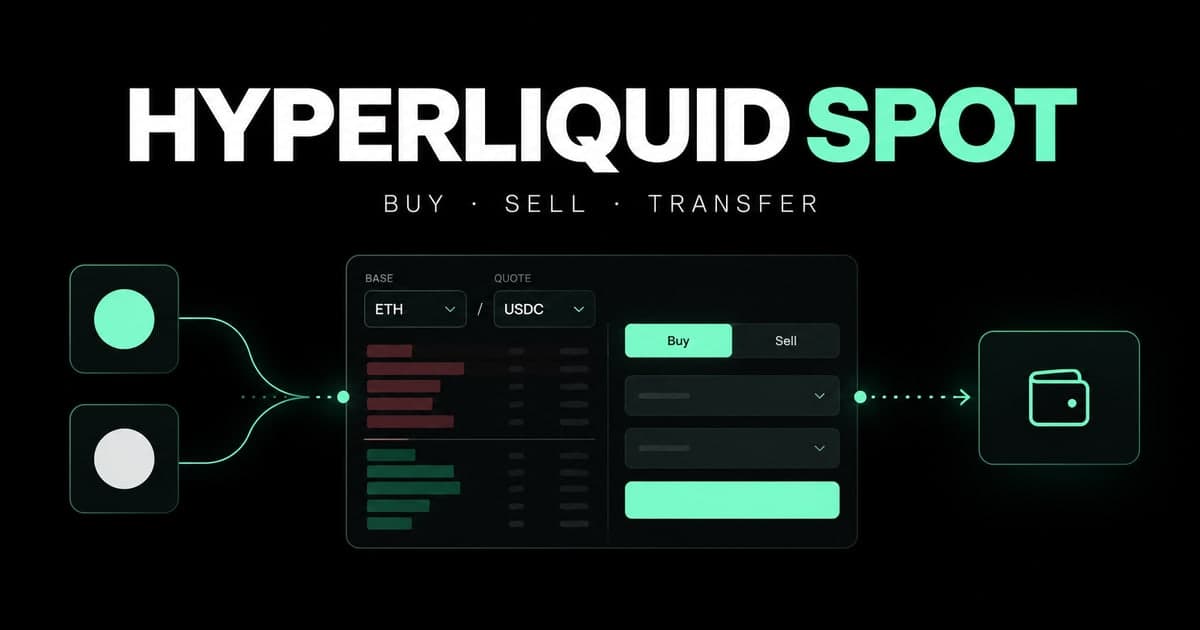
Hyperliquid spot trading exchanges a base token for a quote token on a HyperCore order book. Buying HYPE/USDC, for example, spends USDC and adds HYPE to your spot or unified balance; selling reverses that exchange. The purchase itself has no leverage, funding payment or liquidation price, although token price, liquidity, asset identity and transfer risks remain.
Updated 1 Nov 2026
On this page
- Start with the pair, not the Buy button
- Spot and perpetuals solve different jobs
- What the official spot list looked like on 1 November 2026
- A first spot trade, using $1,000 as the example
- Market order or limit order?
- Spot fees in dollar terms
- After the fill: where the token actually lives
- The risks are different from perps, not absent
- When spot is the simpler choice
- A sensible way to start
A spot trade is an exchange, not a bet recorded as a leveraged position. If you buy a token, it appears in your balance and stays there until you sell, send or transfer it. There is no hourly funding bill and no liquidation simply because the price falls. The token can still lose most or all of its value, and a poor order can still produce an expensive fill.
That sounds simple, but three details cause most avoidable mistakes: reading the pair in the wrong direction, choosing a market order in a shallow book and moving the result to the wrong part of Hyperliquid. This guide focuses on those decisions rather than treating the Buy button as the whole process.
Start with the pair, not the Buy button
Every spot pair has a base asset on the left and a quote asset on the right. In HYPE/USDC, HYPE is the base and USDC is the quote. The displayed price tells you how much USDC one HYPE costs. Buy means spend the quote asset to receive the base asset; Sell means give up the base asset to receive the quote asset.
| Action on HYPE/USDC | Balance spent | Balance received |
|---|---|---|
| Buy HYPE | USDC | HYPE |
| Sell HYPE | HYPE | USDC |
Do not assume every market uses USDC. Hyperliquid now supports permissionless quote assets, so pairs can use other dollar-linked tokens such as USDH, USDT0 or USDE. The quote asset changes what you must already hold, where the proceeds land and which fee adjustments may apply.
Spot and perpetuals solve different jobs
Hyperliquid places spot and perpetual markets in the same trading interface, which makes the distinction easy to miss. Spot is for acquiring or selling a token. A perpetual is for taking long or short price exposure with margin. If the order ticket shows leverage, liquidation or position margin, you are not making a normal spot purchase.
| Feature | Spot | Perpetual |
|---|---|---|
| Result of a buy | Token balance | Long derivative position |
| Can you short without owning the token? | No | Yes |
| Leverage | Not part of the spot order | Available by market |
| Funding | None | Exchanged between longs and shorts |
| Liquidation | No liquidation from an unleveraged spot holding | Possible when margin is insufficient |
| Can the asset be transferred? | Usually, if the token supports the route | No underlying token is purchased |
This difference matters most when the goal is staking, using an app on HyperEVM or sending the token elsewhere. A perpetual cannot do any of those jobs because there is no token balance to move. The HYPE buying guide applies this distinction to HYPE/USDC specifically.
What the official spot list looked like on 1 November 2026
We queried Hyperliquid's public spotMetaAndAssetCtxs endpoint on 1 November 2026 to see how the market list was actually distributed. The response contained 348 registered pairs and 511 token records. At that moment, 287 pairs returned a midpoint, which means a registered pair should not automatically be treated as an active, two-sided market.
| Quote asset | Registered pairs | Share of listed pairs |
|---|---|---|
| USDC | 331 | 95.1% |
| USDH | 11 | 3.2% |
| USDT0 | 5 | 1.4% |
| USDE | 1 | 0.3% |
The useful conclusion is not that USDC will always dominate. It is that the quote asset and live book both deserve a glance before an order. Even in a list where roughly nineteen out of twenty pairs used USDC, seventeen pairs used something else and dozens of registered pairs had no midpoint in the snapshot. Counts and activity can change after publication.
A first spot trade, using $1,000 as the example
Imagine you have $1,000 of USDC and want to buy a token trading at $25. The rough size is 40 tokens before fees and slippage. That arithmetic is only a starting point. The order book decides the actual average price, and the fee reduces the final economic value of the trade.
Place the trade without rushing the checks
Open the official app and choose Spot
Use a trusted bookmark for app.hyperliquid.xyz. In the market selector, make sure the selected product is the spot pair rather than a similarly named perpetual.
Read the pair from left to right
Confirm which token you will receive and which quote asset you will spend. Check that the required quote balance is available in the account mode you use.
Look at the spread and nearby depth
The best bid and ask show the immediate spread. Scan several price levels, not just the first line, to see whether your order would move through the book.
Choose market or limit deliberately
Use a market order when immediate execution matters and the expected slippage is acceptable. Use a limit order when controlling the maximum purchase price matters more than getting filled now.
Review the amount and fee
Leave a small quote-asset buffer. Confirm the order side, size, estimated total and fee instead of relying only on the percentage slider.
Check the completed fill
A submitted limit order may still be open. Review order history and the resulting token balance before planning a transfer or assuming the entire amount was bought.
Market order or limit order?
Neither order type is automatically better. The right choice depends on how urgently you need the trade and how much liquidity is available. A market order controls timing but gives up price certainty. A limit order controls price but gives up execution certainty.
| Order | Useful when | Main drawback |
|---|---|---|
| Market | The book is liquid and execution now matters | The average fill can be worse than the first displayed price |
| GTC limit | You can wait for a chosen price | The order may remain partly filled or untouched |
| Post-only limit | You want the order to rest as maker liquidity | It is cancelled if it would execute immediately |
| IOC limit | You want only the amount available immediately within a price boundary | Any unfilled amount is cancelled |
| TWAP | A larger order should be divided over time | It can fall behind and does not guarantee full completion |
For a small order in a deep market, the difference may be minor. In a thin HIP-1 market, it can be the main cost. If the visible ask is $25 but the next meaningful liquidity sits at $26, a market buy can fill across both levels. A $1 price jump is a 4% difference before the trading fee is even considered.
Spot fees in dollar terms
Hyperliquid's entry-tier base spot rates were 0.070% for taker fills and 0.040% for maker fills when checked on 1 November 2026. The effective rate can be lower through volume and staking tiers, referral discounts and eligible aligned quote assets. A pair between two spot quote assets receives an additional fee reduction under the published rules.
| Order notional | Taker at 0.070% | Maker at 0.040% |
|---|---|---|
| $1,000 | $0.70 | $0.40 |
| $5,000 | $3.50 | $2.00 |
| $25,000 | $17.50 | $10.00 |
These numbers cover the trading fee, not slippage. Saving thirty cents by earning a maker rate is not useful if the market moves several dollars while the order waits. The fee calculator can compare maker and taker costs, but the order book still determines execution quality.
Spot volume counts twice when Hyperliquid calculates the rolling weighted volume used for fee tiers. Trading actions on HyperCore do not charge a separate network gas fee, although deposits, withdrawals and HyperEVM transactions can have their own charges.
After the fill: where the token actually lives
A completed spot buy produces a HyperCore token balance. What that balance can do next depends on the asset and your account mode. Hyperliquid's frontend defaults most users to unified accounts, where an eligible asset has one balance that can also support relevant cross-margin activity. Standard mode keeps spot and perpetual balances separate.
| Location | Typical use | Important distinction |
|---|---|---|
| HyperCore spot or unified balance | Trading, holding and supported native actions | This is where the spot fill appears |
| HyperEVM | Gas, apps and EVM transfers | Only linked assets can move through the Core/EVM transfer flow |
| Staking balance | Native HYPE delegation | HYPE must be transferred from the spot balance first |
| External destination | Withdrawal or supported bridge route | Availability and fees depend on the asset |
HyperCore and HyperEVM are two parts of the same network, but their balances are not interchangeable labels for one location. A supported asset moves through the frontend's EVM/Core transfer action. HYPE is a special case because it becomes the native gas asset on HyperEVM; other linked assets arrive as their associated EVM token. The HyperEVM guide explains that boundary in more detail.
The risks are different from perps, not absent
- Price risk: an unleveraged token cannot be liquidated solely because its price falls, but it can still approach zero.
- Liquidity risk: a thin order book can create a poor average fill and make a later exit difficult.
- Identity risk: short token names and familiar tickers do not replace checking the actual asset details.
- Quote-asset risk: sale proceeds can leave you holding a stablecoin or quote asset with its own issuer and peg risks.
- Transfer risk: sending through an unsupported route or to the wrong environment can make recovery difficult or impossible.
- Account risk: in unified mode, eligible balances may also support cross-margin positions, so a spot asset can be connected to wider account exposure.
- Smart-contract and bridge risk: moving an asset into HyperEVM or across networks adds systems beyond the HyperCore order book.
Tiny balances have another practical wrinkle. Hyperliquid's HIP-1 rules allow eligible spot dust below one lot and no more than $1 of notional value to be processed during the daily dusting cycle. The final USDC received can be lower than the midpoint because the aggregated market sale may experience slippage, and dusting can be skipped when the book is unsuitable.
When spot is the simpler choice
Spot usually fits when the goal requires the token itself: holding HYPE, moving an asset to HyperEVM, staking HYPE or sending a supported token. It also suits someone who wants price exposure without funding payments or a liquidation price. That does not make the trade conservative; it only removes the margin mechanics built into perpetuals.
A perpetual is the more direct instrument when the actual goal is a short position or capital-efficient leveraged exposure and the trader understands margin. Buying spot first and then looking for a way to short it adds steps without solving the same problem.
A sensible way to start
Use a liquid pair, trade a size small enough that the order book is easy to read and confirm the resulting balance before moving anything. The first trade does not need an advanced order type. It needs the correct asset, the correct side and a fill you understand.
Once those basics are clear, maker orders, TWAP execution, alternate quote assets and Core/EVM transfers become useful tools rather than extra sources of confusion. If the account is not funded yet, start with the deposit guide before opening an order ticket.
Frequently asked questions
What is Hyperliquid spot trading?
It is the exchange of one token for another on a HyperCore order book. A completed buy creates a token balance rather than a leveraged derivative position.
Can you short tokens on Hyperliquid spot?
A normal spot sell exchanges a token you already hold. It does not create a short position. Traders seeking short exposure generally use the relevant perpetual market and accept its margin, funding and liquidation risks.
Can a Hyperliquid spot holding be liquidated?
An unleveraged spot purchase has no liquidation price. In unified or portfolio-based account modes, however, eligible balances may support other margin positions, so the wider account configuration still matters.
What are Hyperliquid spot trading fees?
The published entry-tier base rates checked on 1 November 2026 were 0.070% taker and 0.040% maker before account discounts or special quote-asset adjustments. Your live fee tier and order preview are the final reference.
Is HyperCore spot the same as holding a token on HyperEVM?
No. HyperCore spot is the balance used by the native order books. HyperEVM is the EVM environment used for gas, applications and EVM transfers. Supported linked assets can move between them through the official transfer flow.
Sources
- Hyperliquid documentation - HIP-1 native token standard↗ external
- Hyperliquid documentation - Spot API↗ external
- Hyperliquid documentation - Order types↗ external
- Hyperliquid documentation - Fees↗ external
- Hyperliquid documentation - Permissionless spot quote assets↗ external
- Hyperliquid documentation - Aligned quote assets↗ external
- Hyperliquid documentation - Account abstraction modes↗ external
- Hyperliquid documentation - HyperCore and HyperEVM transfers↗ external
- Hyperliquid documentation - How to start trading↗ external