Hyperliquid Bridge Explained: Supported Routes, Fees and Risks
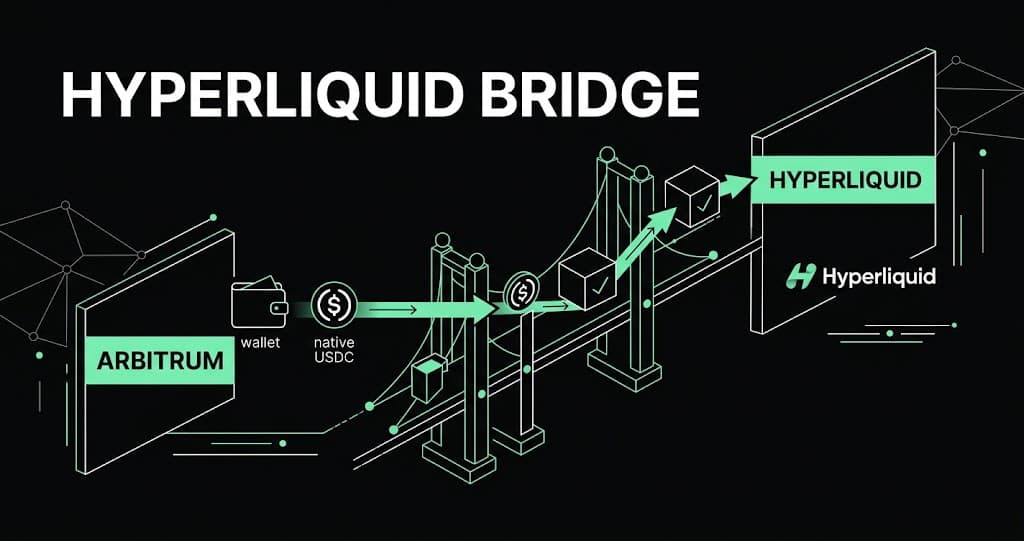
Hyperliquid's native bridge moves native USDC between Arbitrum and HyperCore. Other assets and networks shown in the deposit interface use separate onboarding routes and should not be confused with the native bridge.
Direct answer
What is the Hyperliquid bridge?
The native Hyperliquid bridge moves native USDC between Arbitrum and HyperCore. A deposit requires USDC and ETH for Arbitrum gas, with a documented minimum of 5 USDC. A USDC withdrawal is signed on Hyperliquid, does not require the user to hold Arbitrum ETH, and currently deducts a 1 USDC fee.
Updated 30 Aug 2026
On this page
- How does the native Hyperliquid bridge work?
- Which routes does Hyperliquid support?
- Is bridging the same as depositing on Hyperliquid?
- What do you need to bridge USDC to Hyperliquid?
- What fees does the Hyperliquid bridge charge?
- How long does the Hyperliquid bridge take?
- How do Hyperliquid withdrawals to Arbitrum work?
- Is the Hyperliquid bridge the same as a HyperCore-HyperEVM transfer?
- What are the main Hyperliquid bridge risks?
- What should you check if a Hyperliquid bridge transfer is missing?
A bridge moves an asset between blockchain environments. Hyperliquid's native bridge is the route for depositing native USDC from Arbitrum into HyperCore and withdrawing that USDC back to an Arbitrum address. It is part of the path between an external wallet and the balances used by Hyperliquid's onchain exchange.
The word bridge can cause confusion because Hyperliquid also displays other asset deposit routes, while third-party bridges can move funds from other chains to Arbitrum. These paths may all help a user fund an account, but they do not share the same contracts, assets, fees or support process.
How does the native Hyperliquid bridge work?
For a deposit, the user sends native USDC on Arbitrum to the documented bridge contract through the official interface. Hyperliquid validators observe the deposit. The balance is credited on Hyperliquid after validators representing more than two-thirds of staking power have signed it.
The withdrawal path runs in reverse but is not simply an Arbitrum transaction submitted by the user. Hyperliquid deducts the withdrawal amount from the L1 balance, validators sign the withdrawal, and an EVM transaction requests it from the bridge after more than two-thirds of staking power has signed. A dispute period precedes finalization and distribution to the destination address.
Native bridge flow
The user selects the official deposit or withdrawal action
The interface defines the asset, route and destination. Confirm the app domain and read the transaction details before signing.
The asset crosses the Arbitrum-HyperCore boundary
Deposits begin with native USDC on Arbitrum. Withdrawals begin with the user's available USDC balance on Hyperliquid.
Validators attest to the transfer
The documented threshold is more than two-thirds of stake-weighted validator power for deposits and withdrawals.
The destination balance is credited
A deposit appears on Hyperliquid after validation. A withdrawal reaches the chosen Arbitrum address after the bridge request, dispute period and finalization.
Which routes does Hyperliquid support?
The native bridge has one core route: native USDC between Arbitrum and HyperCore. Hyperliquid's current onboarding documentation also lists direct deposit choices for selected assets on networks including Bitcoin, Ethereum, Solana, Monad and Plasma. Those additional choices are separate deposit rails; some are managed by an independent provider and normally credit the deposited asset to a spot balance before it is sold or used.
| Route | What moves | Where it arrives | Main checks |
|---|---|---|---|
| Native Hyperliquid bridge | Native USDC on Arbitrum | HyperCore USDC balance | Correct USDC contract, Arbitrum network, sender and minimum |
| Additional in-app deposit rail | A supported asset on its named network | Usually the corresponding HyperCore spot balance | Live asset, network, address, minimum and provider terms |
| Third-party bridge to Arbitrum | Assets moved from another chain to Arbitrum | The user's Arbitrum wallet first | Bridge contract, output token, fees, finality and approval risk |
| Centralized-exchange withdrawal | An exchange-supported asset and network | The destination selected by the user | Exact network, token, address, exchange fee and withdrawal status |
Is bridging the same as depositing on Hyperliquid?
A native USDC deposit uses the Hyperliquid bridge, so the two terms often describe the same user action. But deposit is the broader category. A supported BTC deposit on Bitcoin, for example, is an onboarding route shown by Hyperliquid; it is not a BTC transaction through the native Arbitrum bridge.
A third-party bridge adds another step. If USDC starts on Ethereum, Base or another chain, a user may first move it to Arbitrum through an external bridge and then deposit through Hyperliquid's native bridge. The first transaction depends on that third party. The second depends on Hyperliquid's Arbitrum bridge. Each step has its own contract, fee and failure modes.
What do you need to bridge USDC to Hyperliquid?
- Native USDC on the Arbitrum network, using the token accepted by the current deposit interface
- At least 5 USDC, which is the minimum documented for the native bridge
- A small amount of ETH on Arbitrum to pay the deposit transaction's gas
- The wallet address that should receive the corresponding Hyperliquid credit
- The official Hyperliquid application rather than a bridge address copied from a post or message
The minimum is not a recommendation for how much to deposit. It is a contract-processing threshold. The Bridge2 documentation warns that a deposit below 5 USDC is not credited. Hyperliquid support describes a limited email-wallet case where adding more may bring the total above the threshold, but a standard wallet deposit below the minimum may be unrecoverable. Treat 5 USDC as a hard floor and leave room for the Arbitrum gas transaction.
What fees does the Hyperliquid bridge charge?
| Action | Documented or potential cost | Who or what charges it |
|---|---|---|
| Deposit native USDC from Arbitrum | Arbitrum transaction gas | Arbitrum network; paid in ETH |
| Withdraw USDC to Arbitrum | 1 USDC currently documented | Deducted on Hyperliquid to cover validator gas costs |
| Move funds to Arbitrum first | Third-party bridge, network and possible swap costs | The selected external route |
| Convert another deposited asset | Trading fee, spread and possible slippage | The market used for conversion |
The 1 USDC withdrawal charge is not a trading fee and is not reduced by a referral discount. It covers the Arbitrum gas costs handled by validators. Users do not need Arbitrum ETH to submit the Hyperliquid withdrawal, although they may need ETH later to move or use the USDC after it arrives on Arbitrum.
How long does the Hyperliquid bridge take?
Hyperliquid's Bridge2 documentation says a qualifying USDC deposit is normally credited in under one minute. It describes withdrawals as arriving in roughly three to four minutes, while the exchange API documentation uses an approximate five-minute figure. These are normal estimates, not deadlines.
Timing can extend if Arbitrum is congested, validators have not completed the required signatures, the bridge is in its dispute process or a third-party route is delayed. Follow the estimate shown in the live withdrawal modal and check the relevant transaction or explorer record before repeating an action.
How do Hyperliquid withdrawals to Arbitrum work?
A native USDC withdrawal starts in Hyperliquid's withdrawal flow. The user enters an amount and destination address, reviews the 1 USDC charge, and signs. The amount is deducted from the Hyperliquid balance immediately while validators process the bridge withdrawal to Arbitrum.
Checks before withdrawing
Confirm the destination
Use an Arbitrum-compatible address you control or a destination that explicitly supports the exact Arbitrum deposit route.
Leave enough for the fee
The available balance must cover the withdrawal amount and the currently documented 1 USDC charge.
Use Withdraw, not Send
Withdraw crosses to Arbitrum. Send moves an asset to another account on the Hyperliquid blockchain and does not touch the EVM bridge.
Track the recorded action
Check the Deposits & Withdrawals history. For a completed withdrawal, use the explorer link to verify the destination address and transaction.
Is the Hyperliquid bridge the same as a HyperCore-HyperEVM transfer?
No. The native bridge discussed here connects Arbitrum USDC with HyperCore. Moving HYPE or another supported asset between HyperCore and HyperEVM is an internal movement between two execution environments within the Hyperliquid network. It uses separate controls and system-address mechanics.
This distinction matters when diagnosing a missing balance. USDC bridged from Arbitrum should be checked in the relevant HyperCore balance. HYPE transferred to HyperEVM should be checked in an EVM wallet configured for HyperEVM. Repeating either action before identifying the source, destination and network can compound the mistake.
What are the main Hyperliquid bridge risks?
- Wrong-network risk - sending an asset on an unsupported network can prevent it from being credited.
- Wrong-token risk - native USDC, USDC.e, USDT and other stablecoins are not interchangeable at the contract level.
- Minimum-deposit risk - a standard-wallet native bridge deposit below 5 USDC may be permanently lost.
- Address risk - a valid transaction to the wrong destination is still the wrong transfer.
- Contract risk - a bridge depends on contract code and its interaction with validators and external networks.
- Validator and liveness risk - the documented process requires stake-weighted signatures before funds are credited or released.
- Third-party risk - an external bridge, exchange or deposit provider adds separate custody, contract and support assumptions.
- Phishing risk - fake interfaces can request approvals or signatures that do not match the intended bridge action.
- Stablecoin risk - bridged USDC remains exposed to issuer, market and access risks.
Hyperliquid publishes its Bridge2 contract and says the bridge and its staking-related logic were audited by Zellic. Public code and an audit are useful controls, but they do not guarantee that the bridge, wallet, validator set, stablecoin or user action can never fail.
What should you check if a Hyperliquid bridge transfer is missing?
Trace the transfer in order
Identify the exact action
Write down whether it was a native USDC deposit, withdrawal, Hyperliquid Send, third-party deposit or HyperCore-HyperEVM transfer.
Check the source record
For an Arbitrum deposit, inspect the wallet transaction on Arbiscan. For a Hyperliquid withdrawal, check the Portfolio history and its status.
Verify token, network and amount
Confirm native USDC on Arbitrum, a deposit of at least 5 USDC and the correct sending address for the native route.
Check the intended destination
A completed explorer transaction shows where funds went. Also confirm that the wallet is displaying Arbitrum rather than another EVM network.
Wait for the live estimate before retrying
Pending does not mean failed. A duplicate deposit or withdrawal can create a second valid transfer.
Use the correct official support route
Native bridge and independently managed asset routes may have different support owners. Never share a seed phrase or private key with anyone offering recovery.
Frequently asked questions
What network does the Hyperliquid bridge use?
Hyperliquid's native bridge connects Arbitrum and HyperCore for native USDC deposits and withdrawals. Other assets or networks displayed in the deposit interface use separate onboarding routes.
Can I bridge directly from Ethereum or Solana to Hyperliquid?
Not through the native USDC bridge, which uses Arbitrum. Hyperliquid currently shows selected direct asset deposit routes on networks including Ethereum and Solana, but those have separate assets, providers, minimums and rules. Check the live deposit dialog.
What is the minimum Hyperliquid bridge deposit?
The documented minimum for the native Arbitrum USDC bridge is 5 USDC. A standard-wallet deposit below the minimum may not be credited and may be unrecoverable.
How much is the Hyperliquid withdrawal fee?
The official bridge and onboarding documentation currently state a 1 USDC fee for a native USDC withdrawal to Arbitrum. Check the live withdrawal dialog because fees can change.
Do I need ETH to use the Hyperliquid bridge?
You need ETH on Arbitrum to pay gas for a native USDC deposit transaction. You do not need Arbitrum ETH to initiate a USDC withdrawal from Hyperliquid because the current 1 USDC charge covers validator gas costs.
How long does a Hyperliquid bridge transfer take?
The documentation describes qualifying native USDC deposits as normally taking less than one minute and withdrawals as roughly three to five minutes. Network congestion, validator processing and dispute or provider delays can extend those estimates.
Can I deposit USDC.e or USDT through the Hyperliquid bridge?
Do not assume so. The native bridge documentation specifies native USDC on Arbitrum. Use the exact token contract and network shown in Hyperliquid's live deposit interface.
Is the Hyperliquid bridge audited?
Hyperliquid states that the bridge and its staking-related logic were audited by Zellic, and the Bridge2 contract is public. An audit reduces uncertainty but cannot remove contract, validator, network, stablecoin or user-error risk.
Is Hyperliquid Send the same as Withdraw?
No. Send transfers an asset to another account on the Hyperliquid blockchain. Withdraw uses a supported cross-chain route, such as the native USDC bridge to Arbitrum.
Sources
- Hyperliquid documentation - Bridge↗ external
- Hyperliquid developer documentation - Bridge2↗ external
- Hyperliquid documentation - How to start trading↗ external
- Hyperliquid developer documentation - Exchange endpoint↗ external
- Hyperliquid support - Arbitrum USDC deposits↗ external
- Hyperliquid support - Missing withdrawals↗ external
- Hyperliquid documentation - Audits↗ external
- Hyperliquid documentation - How to use HyperEVM↗ external